Psoriasis and Psoriatic Arthritis: Reversing the Inflammation Underneath — Reducing Medication with CSLC-CAP in Kochi
Psoriasis and Psoriatic Arthritis: Reversing the Inflammation Underneath — Reducing Medication with CSLC-CAP in Kochi
- Dr Jolly Thomson
- August 30, 2026
- 0 Comments
Two people arrive in the same week. The first has most of the body involved, photographs what is swept off the bed each morning because nobody believes the quantity, wears long sleeves everywhere so that the face and hands are all anyone sees, and has stopped visiting family — not out of shame exactly, but to spare them. The knees are swollen too. Everything offered so far has helped for a while and then stopped helping.
The second has a few patches on the scalp, treated for two years as stubborn dandruff, and does not yet know that the liver is fatty, the inflammatory markers are up, and the joints are already involved.
Both have the same disease. Neither of them has a skin disease.
This article is about what psoriasis actually is — an imbalance in the immune system that happens to show on the skin — what the medicines for it do and do not do, and what changes when the correction is aimed at the immune system rather than at the rash.
CSLC-CAP is a methodology and treatment for health optimization — a clinically supervised lifestyle-correction approach that works on root causes, delivered at Life Care Centre, Kochi, under modern-medicine doctors. Its purpose is to improve quality of life and to reduce the need for medication and surgical intervention.
Health care and medical care
Medical care treats disease once it has appeared. Health care works on the condition of the body itself, so that it is better able to resist illness and to repair. Both are necessary, and they are not the same work.
In psoriasis the division is unusually visible, because the disease is on the outside where it can be watched. Medical care can quiet it, and quiet it quickly. What it does not do is remove the reason the immune system is behaving this way, which is why the quieting has to continue indefinitely and why the drugs get stronger over the years rather than weaker.
The practical sequence follows from that, and it does not change. Relief first, from whatever is currently working. Correction alongside it. And then, as symptoms settle and repeat testing confirms it, the medicines come down. In that order, and never the other way round.
What “reversal” means here — and what it does not
Reversal here means a measured, sustained reduction in the inflammation driving the disease, and in the load that provokes it — with the skin, the joints and the blood markers all moving together. In practice that is the visible extent and thickness of the lesions, the itching and the scaling, joint pain and morning stiffness, and a set of things that can be counted: hs-CRP, CRP and ESR, the full blood count, liver and kidney function, fasting insulin, and the ratio of lean mass to fat mass.
It is not a claim that the tendency has gone. The honest limit here is structural, and it is the same limit as in every condition this practice works with:
- The inherited predisposition remains. Around thirty per cent of identical twins share the disease — which is another way of saying that seventy per cent do not. What changes is whether the tendency is currently doing damage.
- Kidney failure is the hard limit. Where the kidneys have already failed, this is not the answer, and saying otherwise would be dishonest.
- Joints already deformed or eroded do not straighten. As in every arthritis, what is structural stays structural. Function and pain are a different question, and they do move.
- Scarring that has already formed — on the cornea, in the liver, anywhere — may not clear completely, even where the active disease settles.
Naming the limit is what makes the rest of it believable.
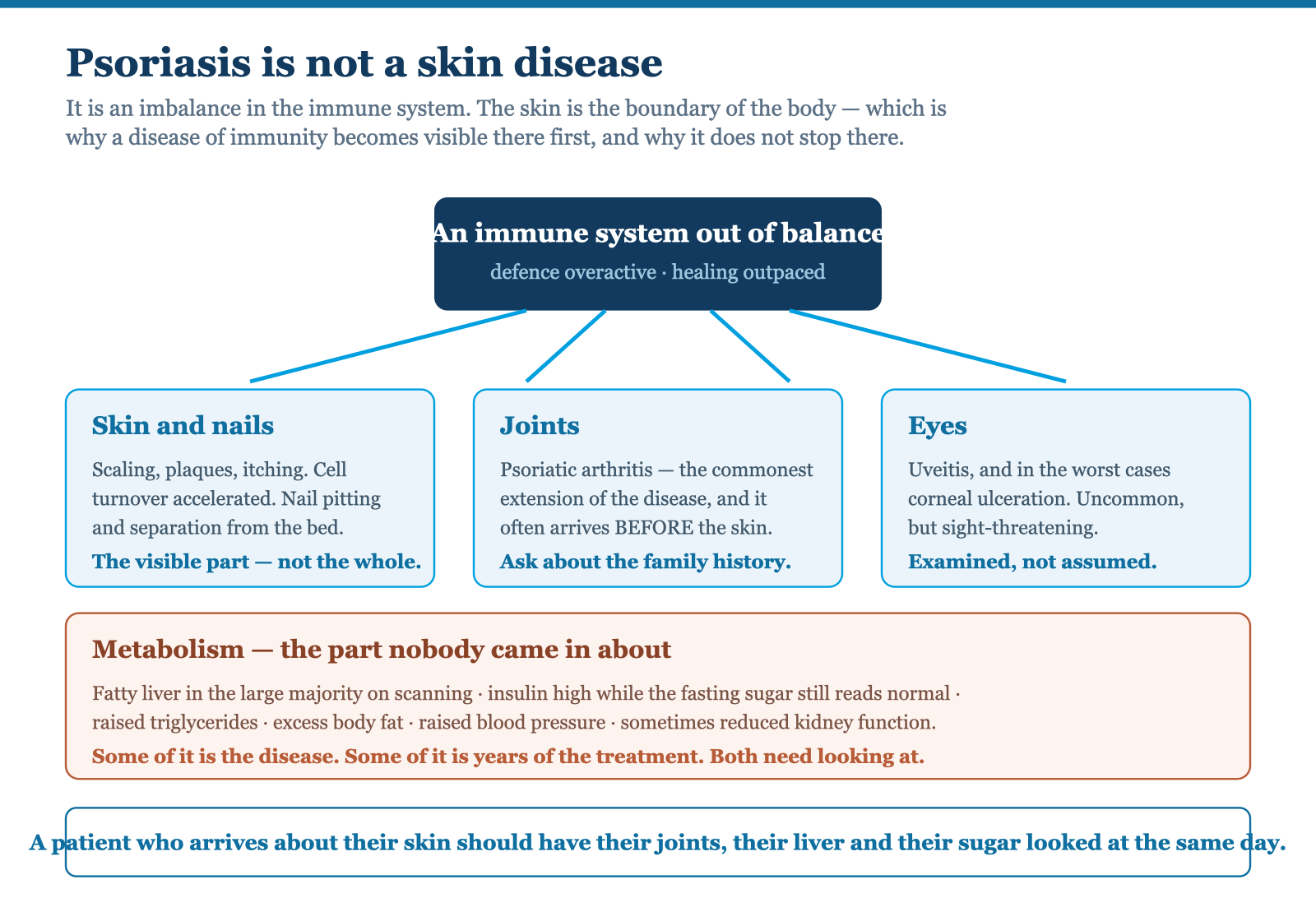
Psoriasis is not a skin disease
It is an autoimmune disease, and the skin is where it becomes visible. That distinction is not a technicality; it decides what is worth treating.
The disease reaches well past the skin. It affects the nails. It affects the joints, and that is the commonest extension of it. It can affect the eyes — uveitis, and in the worst cases corneal ulceration. And alongside it sit the metabolic conditions that travel with chronic inflammation: fatty liver, insulin resistance, obesity, high triglycerides, raised blood pressure.
The skin itself is worth understanding as part of the immune system rather than as a separate organ. It is the boundary of the body — the wall that decides what is inside and what is outside. A disease of the immune system showing up first at that boundary is not a coincidence.
Why psoriatic arthritis often comes first
A great many people assume the joints follow the skin. Frequently they do not. Joint pain, morning stiffness, a swollen finger or toe, or a painful heel can arrive years before a single patch appears — and because there is nothing on the skin to point at, the joint problem gets treated as something else entirely.
The practical consequence is worth stating plainly. Somebody with unexplained joint pain and a family history of psoriasis is a different patient from somebody with unexplained joint pain and no such history, and the family history is a question that often does not get asked.
Inheriting a tendency is not inheriting the disease
Psoriasis runs in families, and patients are frequently told this in a way that sounds like a sentence being passed. It should not.
What is inherited is a susceptibility. What decides whether that susceptibility becomes an active disease is largely environmental — the food, the toxin load, the sleep, the stress, the state of the gut. Those are the parts that can be changed. The genetics cannot be controlled; the epigenetics, which is to say the environment, can — and in a disease like this the environment matters more.
It is also, emphatically, not contagious. That needs saying because patients are treated as though it were, and because it is one of the cruellest parts of the illness.
What is actually happening: two halves of one system
The immune system does two jobs. One is defence — inflammation, the response that attacks what does not belong. The other is healing — repair at cell level, rebuilding what has been damaged. A working immune system holds those two in balance.
In psoriasis the defence half is running far too hot and the healing half cannot keep up. The immune cells stop distinguishing the body’s own skin cells from something foreign, and they attack them. The inflammatory signalling that follows drives the visible disease.
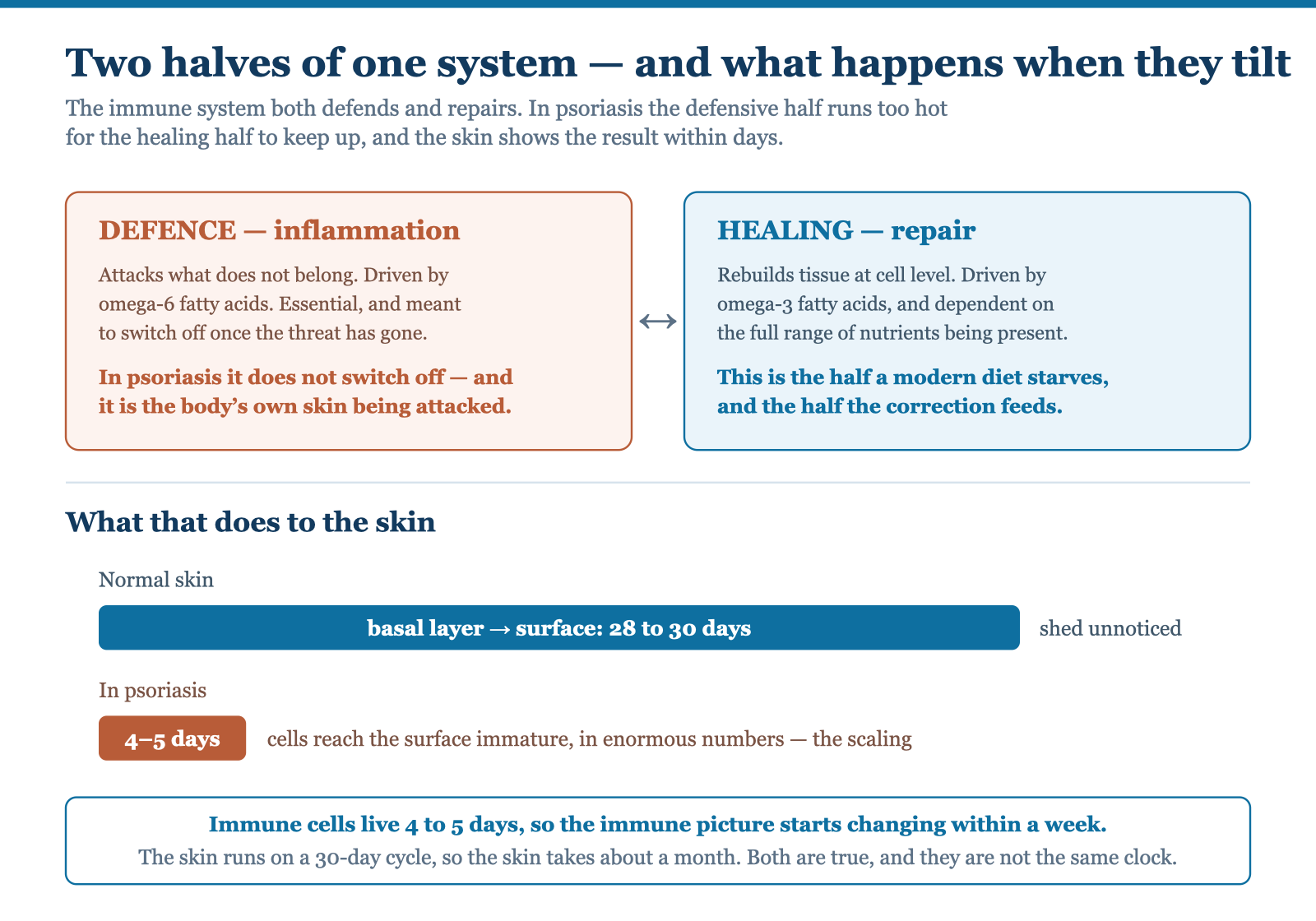
The scaling itself has a precise explanation. A skin cell normally takes twenty-eight to thirty days to travel from the basal layer to the surface and be shed. In psoriasis that journey is completed in four to five days. The cells arrive at the surface immature and in enormous numbers, and that is what the patient is sweeping off the bed.
Two consequences follow, and both matter for what a patient should expect. Because the skin’s own cycle is about thirty days, meaningful clearing of the skin takes about thirty days — it cannot be honestly promised sooner. But immune cells live only four to five days, and in active disease sometimes three or four. Correct what those cells are being built from, and the immune picture starts changing within a week, well before the skin has caught up.
The gut comes first
The gut is the body’s other boundary — a far larger one than the skin, carrying its own population of bacteria and the food that has not yet been broken down.
In psoriasis it is repeatedly involved. Mouth ulcers are common in these patients, and the mouth is simply the visible end of a tube that runs to the other end of the body; where there is ulceration there, there is often ulceration further along, and material crossing into the body that should not. That is one of the mechanisms by which the immune system is provoked in the first place.
It is also why psoriasis so often flares after an infection — a bout of tonsillitis, a streptococcal or staphylococcal infection. That pattern is well recognised, and it is the clearest everyday evidence that this is an immune disease rather than a skin complaint.
The fats, and why they decide inflammation
Of the nutrients that matter here, the fats matter most, because they are the controllers.
Omega-6 fatty acids drive the inflammatory side of the immune response; omega-3 fatty acids drive the anti-inflammatory, healing side. Both are essential and both are needed. The problem with a modern diet is the proportion: omega-6 is present in very large amounts, and omega-3 often only in traces. An immune system built from that mixture is weighted towards inflammation before anything else has gone wrong.
The working target here is a ratio of about 1:1, with around 1:4 generally acceptable. Trans fats and hydrogenated fats push the same balance the wrong way, and excess body fat does too — which is one reason body composition is treated as a clinical measurement in this practice rather than a cosmetic one.
⚠️ One caution that is easy to get wrong. Omega-3 is a fragile fat, and simply eating large quantities of high omega-3 seeds is not the answer and can do harm. It has to arrive alongside the antioxidants and micronutrients that protect it — zinc, selenium, the B-complex vitamins and the rest. Correcting one nutrient in isolation is not a correction.
The fifty-seven
The body is built from what is put into it, and repair is not possible without the materials. The list is finite and it is known: oxygen, water, fourteen vitamins, fourteen minerals, around twenty amino acids, four fatty acids, sugars, starch and dietary fibre.
Nutrition here means supplying that full range, in a form dense enough to deliver it and clean enough not to add to the load. It does not mean a general instruction to eat healthily, and it does not mean supplementing whatever happens to be fashionable. In a disease where the skin is being rebuilt every few days and the joints are inflamed, the raw materials for repair are not optional.
What the medicines do — suppress, or modulate
The treatment ladder in psoriasis is well established and it works. It should be described fairly.
- Topical treatments — applications for the itching, the scaling and the thickening, coal tar preparations and topical steroids.
- Phototherapy — PUVA and narrowband ultraviolet treatment, using psoralen with ultraviolet light.
- Systemic drugs — oral steroids, methotrexate, ciclosporin and related agents.
- Biologics — monoclonal antibodies given by injection, weekly or monthly, with new agents appearing constantly. They are effective and they are expensive; a single injection can cost tens of thousands of rupees, though insurance often covers it.
What every one of them has in common is that they suppress or modulate the immune system. That is the mechanism, and it is why they work. It is also why the disease returns when they stop.
There is a fact about this class of drug that patients are rarely told and should be. Several of them are cancer drugs. Methotrexate is an antimetabolite used in oncology; a number of the immune-modulating agents are the same molecules used in cancer immunotherapy. That is not an argument against them — it is an argument for knowing what is being taken and why.
The trade-offs are real. Long-term steroids bring weight gain and diabetes, and diabetes brings its own prescription and the rest of the metabolic cascade with it. Methotrexate suppresses the bone marrow, and a falling white cell count is a finding that needs acting on. Long-term use has been associated with effects on the eyes. And there is a list of medicines — some antihypertensives, antimalarials and others — that can induce or worsen psoriasis: if lesions appear while a new drug is being taken, the drug itself is worth questioning.
The alternative aim is not suppression but balance — reducing what is provoking the immune system, and supplying what the healing half needs, so that the defensive half is not required to run so hot. That is a slower idea than an injection, and it is the one that does not have to continue forever.
When several conditions travel together
Almost nobody with long-standing psoriasis has only psoriasis.
On scanning, the large majority of these patients are found to have fatty liver. On blood testing, many are already insulin resistant — the fasting sugar may be normal while the insulin is high, which is pre-diabetes whether or not it has been called that. Triglycerides and cholesterol are commonly raised. Overweight or frank obesity is usual. Kidney function is sometimes affected. And in patients on long-term treatment, some of this is the treatment’s doing rather than the disease’s.
What is repeatedly seen here is that when the underlying inflammation is corrected, these move at the same time — not as a pleasant side effect, but because they were sitting on the same foundation. That is the argument for treating the body rather than the lesion, and it is why a patient who arrives about their skin should have their liver, their sugar and their joints looked at on the same day.
One patient’s course
What follows is one patient, described to show how the pieces move together. It is not a typical result and is not offered as one — what any individual can expect depends on how much capacity the body still has to repair.
She arrived carrying most of what this article has described, at once: psoriasis of long standing, psoriatic arthritis, diabetes needing daily insulin, high blood pressure, and — the part nobody expects on a psoriasis list — corneal ulceration, under ophthalmology care, with the sight in that eye largely gone. She was on methotrexate, and her rheumatologist had advised moving to a biologic, at a cost per injection running into tens of thousands of rupees.
The insulin was the first thing to become unnecessary, and it stopped on the first day, with the sugars settling within a day or two. The oral medicines came down over the following weeks as symptoms settled and repeat reports allowed it, and within about a month she was off them. The joints and the skin had settled in that time. The steroid eye drops were reduced last and most slowly, because an eye under active treatment is not something to hurry.
What was not expected was the eye. The vision came back. What did not come back was the scarring already formed on the outer part of the cornea — that is structural, and it stayed. So the honest summary is that the active disease settled across four conditions at once, and the one thing already destroyed remained destroyed.
That is the argument of this article in a single patient. Nobody set out to treat her eye.
Where this does most, and where it does least
The ranking below is from clinical experience in this practice, not from trial data, and is offered in that spirit.
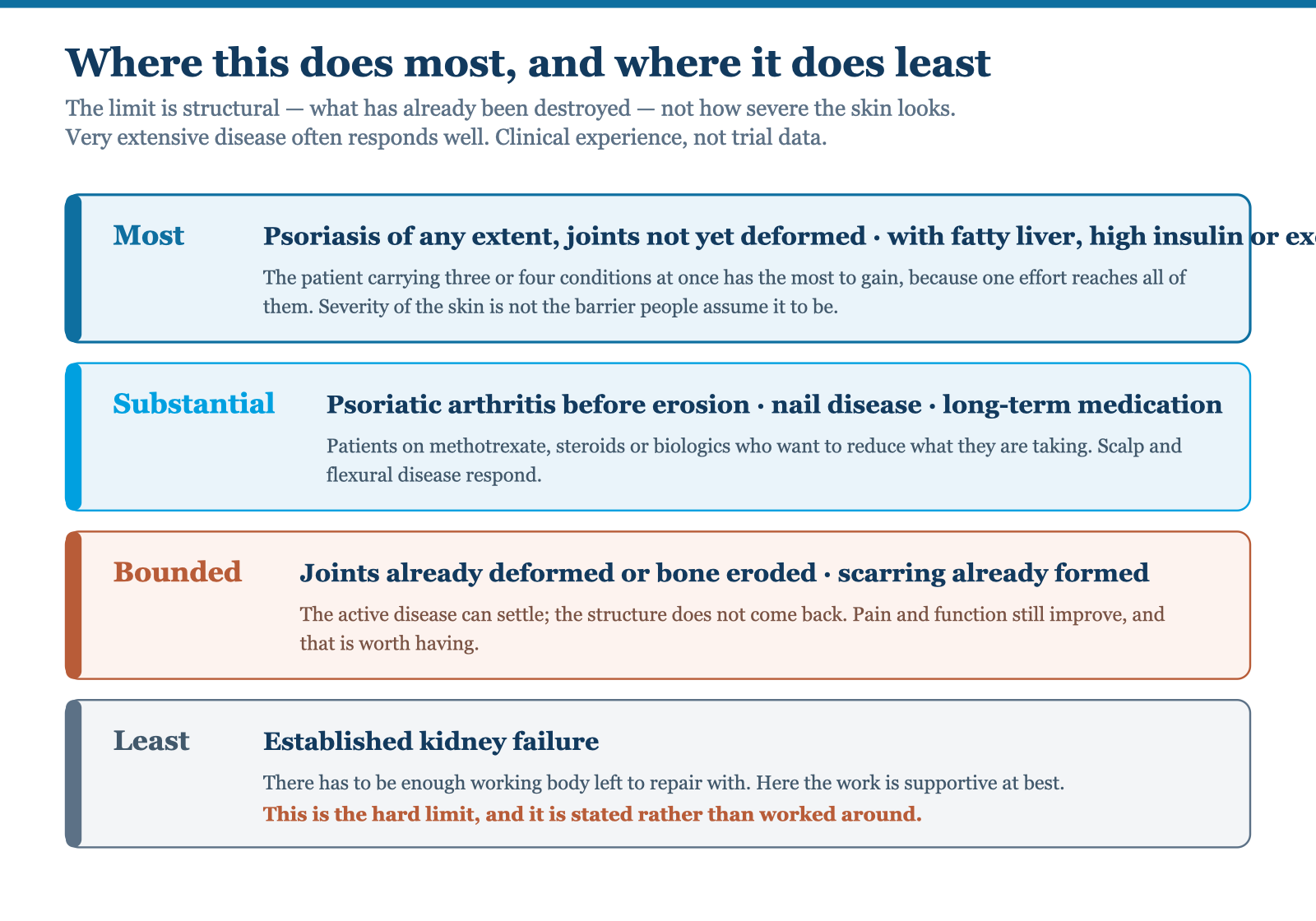
Most — psoriasis of any extent where the joints are not yet deformed, particularly alongside fatty liver, insulin resistance or excess weight. Severity of the skin is not the barrier people assume it to be; very extensive disease often responds well, and the patient carrying three or four conditions at once has the most to gain, because one effort addresses all of them.
Substantial — psoriatic arthritis before erosion has occurred, nail disease, and patients on long-term methotrexate, steroids or biologics who want to reduce what they are taking. Scalp and flexural disease respond.
Real, but bounded — where joints are already deformed or bone already eroded, and where scarring has formed. The active disease can settle; the structure does not come back. Function and pain still improve, and that is worth having.
Least — established kidney failure. Here the work is supportive at best, and the honest answer is that this is not the treatment for it.
What patients experience, and when
Two timelines run in parallel, and confusing them is the commonest source of disappointment.
Symptomatic relief comes early — often within days. The itching settles, and with it the sleep. Patients who have not slept properly for weeks because of the itching frequently report a full night within the first day or two, and that alone changes what the rest is like.
The skin takes about a month, because that is how long the skin’s own cycle is. Meaningful clearing at thirty days, with continued improvement after it, is the realistic expectation. Anyone promising a cleared skin in a week is describing a drug effect, not a repair.
The joints move on their own schedule, generally with the inflammatory markers rather than with the skin.
Monitoring is weekly at first — inflammatory markers, the blood count, and whatever else the individual case requires — then fortnightly, then monthly. The purpose of measuring that often is not reassurance. It is that the medication reduction depends on it, and reducing medication on the basis of how somebody feels is not safe.
Medication — how reduction actually happens
Nobody is asked to stop a medicine in order to start this. The sequence is the other way round.
Relief comes first. Where a patient is in real distress — heavy exfoliation, severe itching, an inflamed joint — a short course for symptomatic relief is part of the treatment and not a defeat. Correction runs alongside it. Then, as the symptoms settle and repeat testing confirms the change, the medicines come down.
The tapering is gradual, doctor-led and driven by the reports. Methotrexate, for example, is stepped down in stages with the symptoms and the blood count checked at each step, rather than stopped. Where the blood count is already low because of the drug, that is a reason to reduce it sooner rather than later — and the count characteristically recovers as the dose falls and the nutrition improves. Steroid drops and topical steroids come down last and slowest, particularly where an eye is involved.
Depending on the patient’s condition, coming off the medicines takes somewhere between one and three months. Some come off all of them; some do not, and reducing to the smallest effective dose is a real result in itself.
Toxins, sleep and the flare cycle
Stress provokes a flare. The flare causes itching. The itching destroys sleep. Poor sleep raises inflammation, which provokes the next flare. It is a genuine loop, and it can be entered from any point — which also means it can be interrupted from any point.
Sleep is treated as clinical, not incidental. The immune system does much of its repair during sleep. Melatonin is released in darkness, so screens late at night are not a lifestyle quibble but a direct interference with the mechanism. The approach here is to restore the rhythm rather than to prescribe something to induce it.
The toxin load is worth taking seriously and is largely within a patient’s control. Food colourings, preservatives and taste enhancers; food that has travelled across the world and been treated to survive the journey; detergent residue in clothing worn against inflamed skin — rinsing several times, and preferring plain cotton, is a small thing that patients notice; perfumes and cosmetics applied to broken skin; hot food served in plastic. None of these is the cause of psoriasis. All of them add to a load that an overactive immune system is already struggling with.
The most useful single instruction is also the simplest: reduce the number of ingredients. Eat food with few components in it, and it becomes possible to identify what actually provokes a reaction — which cannot be done while fifty ingredients are arriving at once.
The four optimization domains
| Domain | What it addresses |
|---|---|
| Optimal nutrition | Supplying the full range of nutrients the body needs in order to repair — oxygen and water, fourteen vitamins, fourteen minerals, around twenty amino acids, four fatty acids and dietary fibre — in a nutrient-dense form with minimal additives. In psoriasis the balance of fats is not general advice but acts on the mechanism itself, and omega-3 is supplied alongside the antioxidants and minerals that protect it rather than on its own. |
| Optimal exercise | Gentle, segmental movement performed lying down and then sitting, working through the body part by part in a set order — around 650 muscles, activated systematically, and graded to what the person can manage. No gym or equipment is involved, so it remains possible when joints are painful and swollen, which is exactly when conventional exercise advice fails. |
| Rest and sleep | Recovery, without which repair does not function well however good the nutrition. The immune system does much of its repair during sleep, and in psoriasis sleep is often the first thing the disease takes away. |
| Reduced toxin load | Lowering avoidable exposure — food additives, preservatives and colourings first, then detergents and cosmetics reaching inflamed skin, then alcohol and tobacco. Excess body fat and excess circulating glucose are treated as part of the same load, because the body handles them the same way. |
Delivered together and consistently, these same four domains are intended to create favourable conditions at cell level: better delivery of oxygen and nutrients into cells, and better clearance of waste out of them.
Watch the full sessions
The two sessions below, recorded with patient case studies, cover this subject in full and go public on 31 August 2026 — the English session and its Malayalam counterpart. Beneath them are the published four-part series and the foundation sessions that explain the approach itself.
English — psoriasis and psoriatic arthritis, beyond steroids and methotrexate (31 August 2026):
Malayalam — the same session (31 August 2026):
English — clinically supported lifestyle correction in psoriasis care:
Malayalam — what causes psoriasis:
English — the approach itself:
Malayalam — the approach itself:
Why the first 90 days matter
The active phase is ninety days because that is roughly the period over which a large proportion of the body’s cells are renewed, and over which corrected inputs show up in measurements rather than only in how someone feels. In psoriasis there is a shorter clock running inside it — the skin’s own thirty-day cycle — which is why the visible change and the measured change do not arrive together.
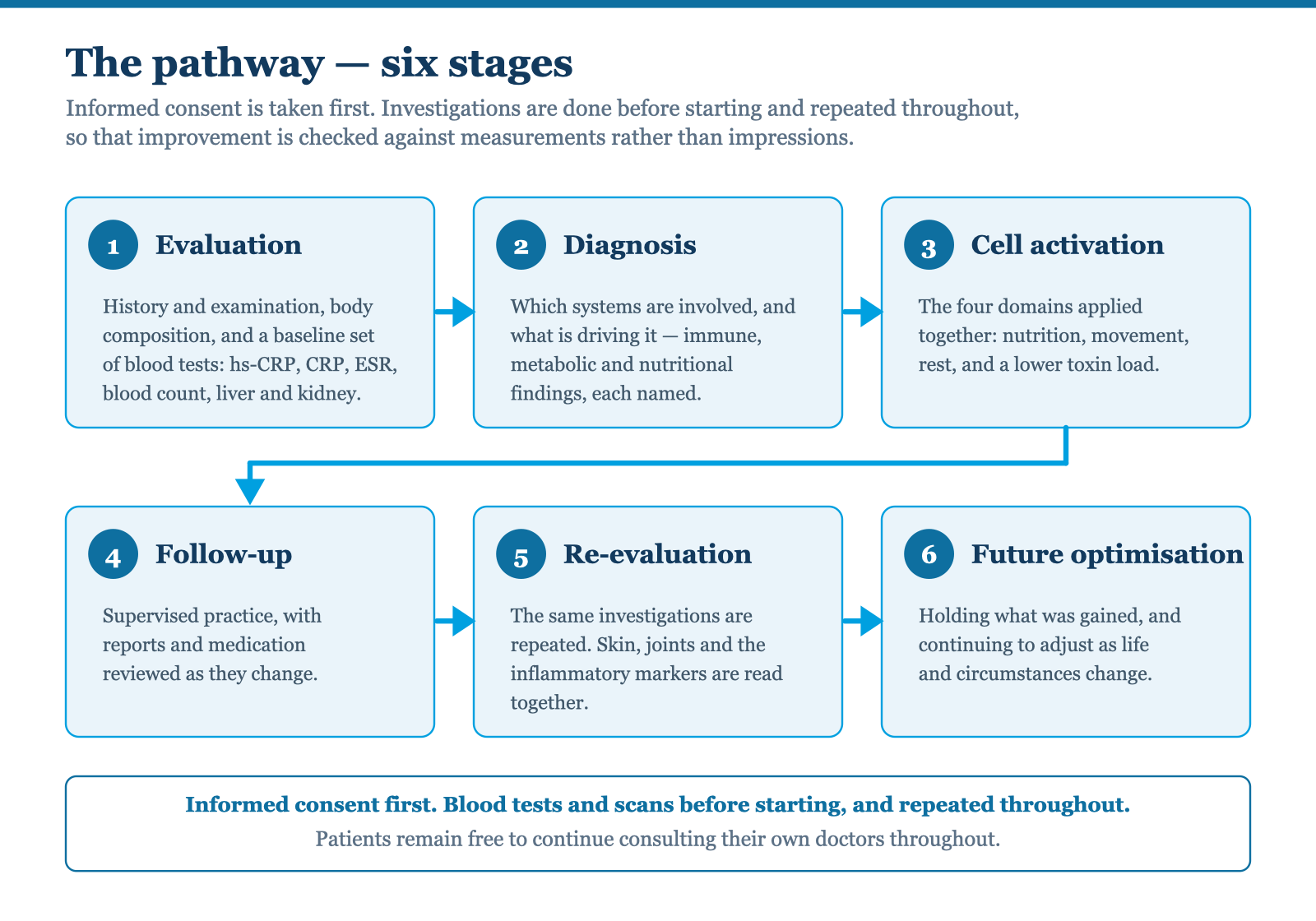
This is not an inpatient treatment, and it is better that it is not. The correction has to be built into the life the patient actually lives, in their own kitchen — a result achieved in a hospital tends to be lost on the way home. In practice that means the first few visits about a week apart, then fortnightly, then monthly. Patients travelling from outside Kerala or from overseas are asked to plan on three to four weeks in Kochi for the teaching, after which follow-up continues remotely.
One part genuinely cannot be done at a distance: the movement protocol has to be taught in person before it can be practised. Everything after the teaching can be supported remotely, and routinely is.
Suitability
To take part, a patient must be clinically stable, and fit mentally and physically — able to understand, learn and practise the routine, able to take at least a liquid diet along with the centre’s nutritional support, and able to do gentle exercise lying down and sitting. A patient should be able to walk in, with support if necessary. The first 90 days must be given real priority. Where physical or mental limitation prevents independent practice, a family member enrolls alongside — and in the more difficult cases, that family support is what decides the result.
It is not suitable where an organ has already failed — established kidney failure in particular, very poor cardiac function, a decompensated liver, or a degree of cognitive or psychological instability that makes learning the routine impossible. There has to be enough working body left to repair with.
It is also worth saying what happens when it does not work. Where a patient is not improving — most often because circumstances have made the protocol impossible to follow rather than because the biology has refused — the course is to continue under dermatology and rheumatology care. That care is theirs throughout in any case: patients remain free to keep consulting their own doctors, and are encouraged to.
Frequently asked questions
Is psoriasis contagious?
No. It cannot be caught from another person or passed to one, by touch or in any other way. It is an immune condition, not an infection. This is worth saying plainly because patients are often treated as though the opposite were true, and the isolation that causes does real harm of its own.
My mother has psoriasis. Will I get it?
A tendency can be inherited; the disease is not. Among identical twins — who share all their genes — roughly thirty per cent both develop it, which means most do not. What decides the outcome is largely environmental: food, toxin load, gut health, sleep and stress. Those are the parts that can be changed, and in this disease they matter more than the genetics.
Can I come off methotrexate or my biologic?
Often, yes — but not by stopping it. The sequence is that correction runs alongside whatever is currently working, and the dose comes down in steps as symptoms settle and repeat blood tests confirm the change, under the doctor who prescribed it. Methotrexate in particular is reduced gradually with the blood count checked at each step. Depending on the case, coming off takes between one and three months, and reducing to the smallest effective dose is a real result even where stopping is not possible.
How long before my skin clears?
The itching usually settles within days, and sleep returns with it. The skin itself takes about a month, because a skin cell’s journey from the basal layer to the surface is a thirty-day cycle — in psoriasis it is being completed in four or five days, and it has to be returned to its proper pace before the surface can look normal. Meaningful clearing at thirty days with continued improvement afterwards is the honest expectation.
Is psoriatic arthritis treated differently from the skin?
The correction is the same, because it is the same disease and the same immune imbalance. What differs is what is measured and how quickly it moves: the joints tend to follow the inflammatory markers rather than the skin, and where a joint is already deformed or the bone eroded, that part is structural and does not come back. Pain and function still improve.
What about diet — is there one food to avoid?
There is no single food that causes psoriasis, and lists circulated online are not a substitute for finding out what provokes a reaction in one particular person. The practical method is to reduce the number of ingredients in the diet far enough that individual reactions become visible, correct the balance of fats, and supply the full range of nutrients so that repair is possible. Testing is used where it helps. What matters as much as any exclusion is what is being supplied.
Does stress really cause flares?
It does, and the loop runs both ways — stress provokes a flare, the flare causes itching, the itching destroys sleep, and poor sleep raises inflammation and provokes the next flare. That is why sleep is treated as part of the clinical work rather than as advice, and why relief of the itching in the first days matters more than it appears to.
Related reading
- Autoimmune Diseases: Reversing Autoimmune Inflammation — the immune mechanism in full, and what “reversal” means where a tendency is inherited.
- Arthritis: Reducing Medication and the Need for Surgery — the joint side of this disease, and the clearest account in this series of what “structural” means as a limit.
- Fatty Liver: Reversing Liver Fat and Fibrosis — the comorbidity found in the large majority of these patients, usually without their knowing.
- Weight-Loss Injections and Diabetes — insulin resistance and excess body fat, which drive inflammation and travel with psoriasis more often than not.
- Age-Related Lifestyle Diseases: Reversing Insulin Resistance and Inflammation — inflammaging, the background against which all of this sits.
- CSLC-CAP — approach summary and information sheet — consent, investigations, the pathway and eligibility in one place.
Important note
⚠️ IMPORTANT: This article is educational and is not medical advice. Do not start, stop or change any medication without your treating doctor’s supervision.
The clinical observations described here are from this practice, reported as clinical experience rather than as a trial. Individual results depend on how closely the protocol is followed and on how much capacity the body still has to repair. Whether to accept or decline any treatment is a decision for the patient and their family. Use this article to ask better questions of your own doctors, and to decide together.